
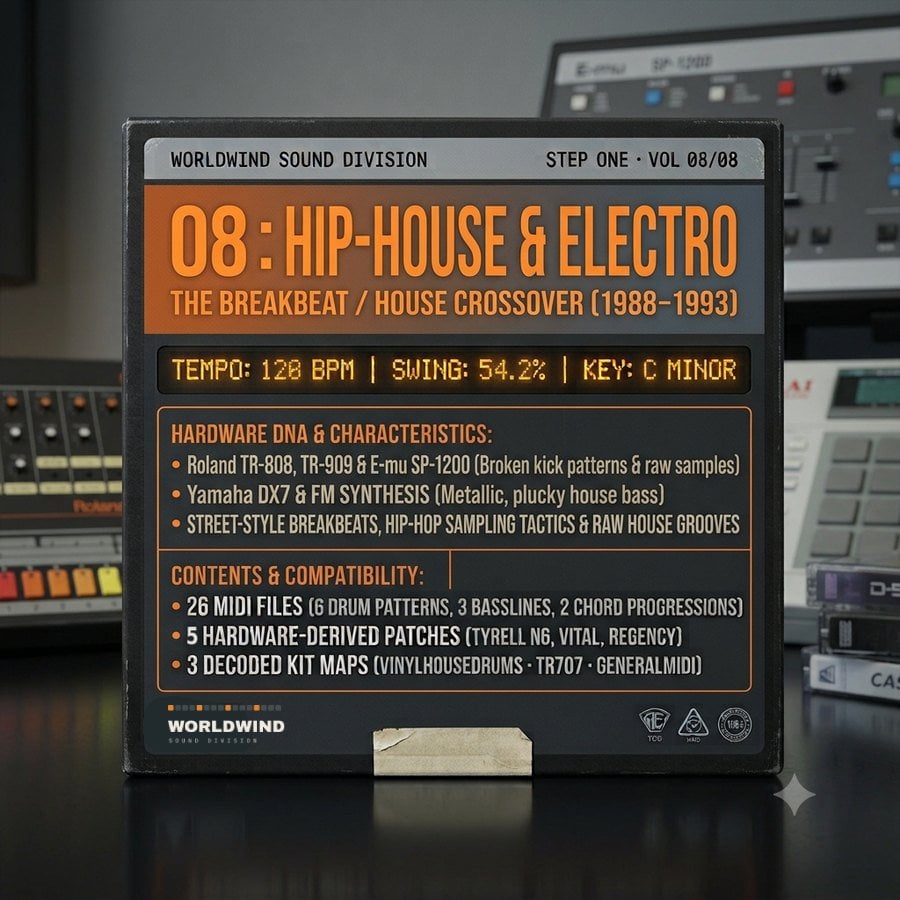
HIP-HOUSE & ELECTRO — The crossover that changed the floor
HIP-HOUSE & ELECTRO
Fast Eddie, Tyree, and the rap-house crossover, 1987–1990
120 BPM · 54.2% Swing · C minor
The sound of the crossover
Hip-house emerged at the point where Chicago house and hip-hop became close enough to collide. Producers like Fast Eddie and Tyree Cooper began setting rapped vocals over house tempos and drum programming, creating something that felt too fast for hip-hop heads, too rap for house purists, and exactly right for the floor.
Beneath that sat the older electro lineage — Kraftwerk, Afrika Bambaataa, and the machine-driven pulse of the 808 and 909. That is what gives this volume its character: house on one side, rap on the other, and electro holding the center.
How it feels
This collection is busier and more flexible than straight house. The kick often breaks away from four-on-the-floor into syncopated, hip-hop-influenced patterns, while claps and snares carry more of the movement.
The swing is lighter, sitting between the straight electro feel and the looser house shuffle. The bass follows the broken rhythm rather than running in steady sixteenths, and the stabs stay bright, short, and clear of the vocal.
What’s inside
MIDI/Drums
Drums, bass, and chords as MIDI, supplied across three kit maps.
Patches
5 patches for Tyrell N6 and Vital.
Total: 26 MIDI files and 5 patches.
Included patches
Bright Stab [Tyrell N6]
A short, bright chord stab with fast attack, quick decay, and light chorus for offbeat hits.
Electro Sub [Tyrell N6]
A deep 808-style sub bass with a rounder low end and more sustain for the electro patterns.
Hip Bass [Tyrell N6]
A punchy crossover bass designed to move with the broken kick, with square and saw layers and moderate resonance.
Rave Organ [Tyrell N6]
A hollow organ stab with minimal chorus and enough punch to sit between hip-house and the rave sound that followed.
Sub [Vital]
A clean sine-led sub layer for added weight under the main bass.
Why this volume matters
HIP-HOUSE & ELECTRO captures the breakbeat phrasing, rap-house energy, and digital punch that made this crossover feel new in 1988. It is built for producers who want rhythm with attitude and a groove that keeps moving without collapsing into straight four-on-the-floor.