
DETROIT TECHNO — The Belleville future sound
DETROIT TECHNO
Atkins, May and Saunderson — the Belleville Three, 1985–1990
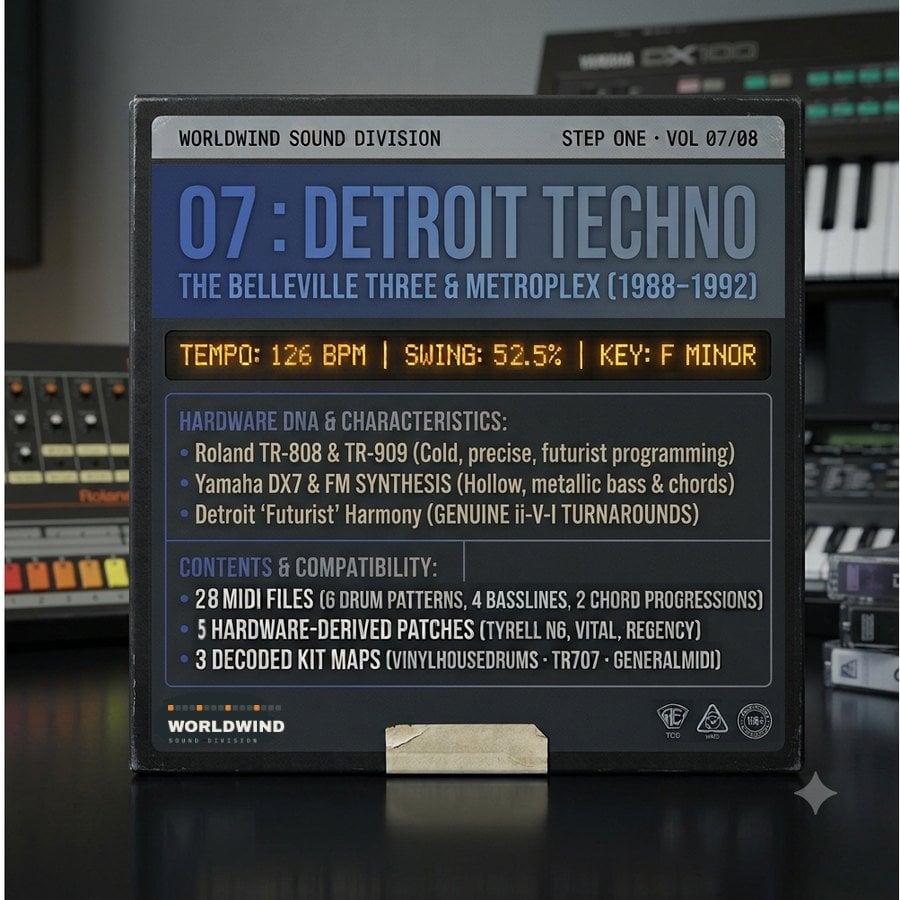
126 BPM · 52.5% Swing · F minor
The sound of the future
Detroit techno came from three teenagers in Belleville who heard European synth-pop, Chicago house, and the futurism of George Clinton and Alvin Toffler, then turned all of it into something colder, cleaner, and more forward-looking. Juan Atkins gave it a name, Derrick May gave it emotional scale, and Kevin Saunderson gave it pop clarity
Where Chicago house was warm and physical, Detroit techno felt like machines thinking out loud. It was the same drum-machine vocabulary, but aimed at motion, abstraction, and the future rather than the sweat of the room
How it feels
This folder is faster and straighter than house, with almost no swing. The feel is intentional and mechanical, not loose
The signature sound is the string stab or detuned brass chord: bright, slightly cold, and usually voiced high so it hits staccato on the offbeats. The bass leaves space instead of filling it, and the harmony leans on suspended and unresolved shapes that keep the record moving forward
What’s included
MIDI/Drums
Drums, bass, and chords as MIDI, supplied across three kit maps
Patches
5 patches for Tyrell N6 and Vital
Total: 28 MIDI files and 5 patches
Included patches
Cold Brass [Tyrell N6]
A detuned brass chord with a colder edge, built for the harder Detroit records
Detroit Bass [Tyrell N6]
A spare Model 500-style bass with square and saw layers, moderate resonance, and room to breathe
Futurist Pad [Tyrell N6]
A slow-evolving pad for spacey intros, with long attack, long release, chorus width, and a touch of pitch drift
String Stab [Tyrell N6]
The classic Detroit string-stab sound: two detuned saws, chorus, and a bright, slightly cold attack
Sub [Vital]
A clean sine-led sub layer for added weight beneath the main bass
Why this pack works
DETROIT TECHNO gives you the spare bass lines, staccato chords, and machine-driven energy that defined the Belleville sound. It is built for producers who want forward motion, emotional restraint, and a sharper sense of purpose in the arrangement
Load it. Keep it lean. Let it drive.